


Trekkers Nepal
Registered
On the morning of August 26, 2026, a huge flash flood swept down the Trishuli and Bhotekoshi rivers in northern Nepal. It hit villages, roads, and bridges in the Rasuwa, Nuwakot, Dhading, and Gorkha districts, north of Kathmandu.
Experts say the flood started when a glacier and rockslide collapsed near the Nepal–Tibet border. This blocked a small tributary stream. When the blockage broke, a massive wall of water rushed downstream without warning.
The damage was severe. Many people lost their lives, and hundreds are still missing, including some foreign tourists. Dozens of bridges and long stretches of road were washed away. Hydropower stations, homes, and markets in towns like Syabrubesi and Timure were badly damaged too.
Because it happened during the monsoon and right before the busy autumn trekking season, many trekking agencies, tour operators, and travelers started asking one big question: Is it safe to trek in Nepal right now?
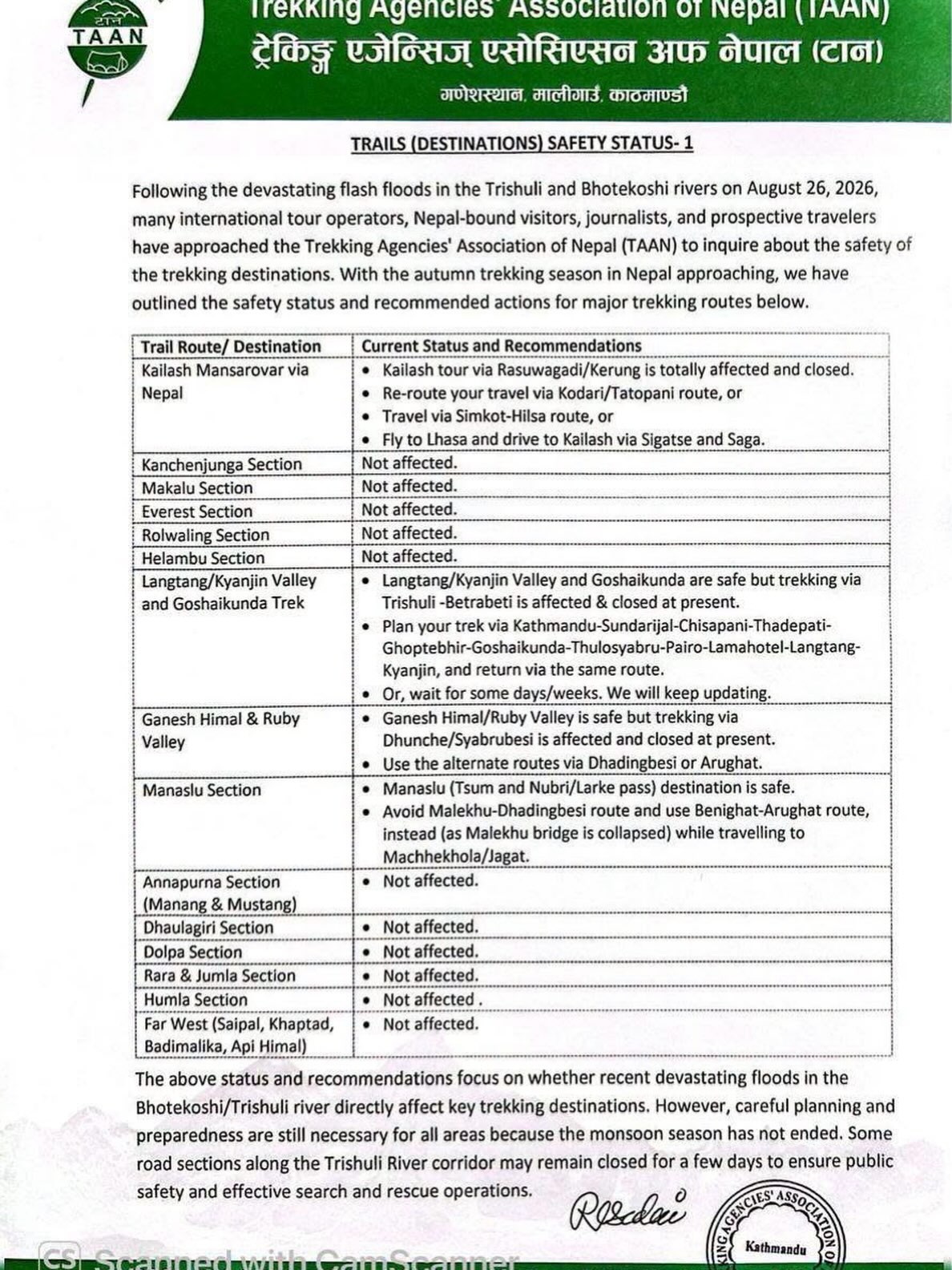
The Trekking Agencies' Association of Nepal (TAAN) released a safety notice to answer this question clearly. Here is what it says in simple terms.
Nepal's major trekking destinations, including Everest, Annapurna, Manaslu, Langtang (the valley itself), and many others, remain open for the autumn 2026 season, sometimes with simple detours. With good planning and by staying updated through official sources like TAAN, trekkers can still enjoy a safe and memorable trip to the Himalayas this season.
Information based on TAAN's official "Trails (Destinations) Safety Status - 1" notice and recent news reporting following the August 26, 2026 floods.
Experts say the flood started when a glacier and rockslide collapsed near the Nepal–Tibet border. This blocked a small tributary stream. When the blockage broke, a massive wall of water rushed downstream without warning.
The damage was severe. Many people lost their lives, and hundreds are still missing, including some foreign tourists. Dozens of bridges and long stretches of road were washed away. Hydropower stations, homes, and markets in towns like Syabrubesi and Timure were badly damaged too.
Because it happened during the monsoon and right before the busy autumn trekking season, many trekking agencies, tour operators, and travelers started asking one big question: Is it safe to trek in Nepal right now?
The official answer from TAAN
The Trekking Agencies' Association of Nepal (TAAN) released a safety notice to answer this question clearly. Here is what it says in simple terms.
Areas affected by the flood
- Kailash Mansarovar route via Rasuwagadhi/Kerung is completely closed for now.
- Travelers should use alternate routes instead: via Kodari/Tatopani, via Simkot-Hilsa, or by flying to Lhasa and driving to Kailash through Sigatse and Saga.
- Langtang/Kyanjin Valley and Gosaikunda Trek: The valley and lake area itself are safe, but the usual road through Trishuli-Betrabeti is closed. Trekkers can still go by trekking the alternate trail: Kathmandu–Sundarijal–Chisapani–Thadepati–Ghoptebhir–Gosaikunda–Thulosyabru–Pairo–Lamahotel–Langtang–Kyanjin, and returning the same way. Or simply wait a few weeks for updates.
- Ganesh Himal and Ruby Valley: The trekking area is safe, but the Dhunche/Syabrubesi road is closed. Use the Dhadingbesi or Arughat routes instead.
- Manaslu Section (Tsum Valley, Nubri, Larke Pass): The trekking area is safe. However, avoid the Malekhu–Dhadingbesi road because the Malekhu bridge has collapsed. Use the Benighat–Arughat route instead when heading to Machhekhola or Jagat.
Areas NOT affected at all
The good news is that most of Nepal's major trekking regions are completely untouched by the flood. These remain open and safe as usual:- Everest Section
- Annapurna Section (Manang and Mustang)
- Dhaulagiri Section
- Kanchenjunga Section
- Makalu Section
- Rolwaling Section
- Helambu Section
- Dolpa Section
- Rara and Jumla Section
- Humla Section
- Far West region (Saipal, Khaptad, Badimalika, Api Himal)
Tips for trekkers and tourists planning autumn 2026 travel
- Check before you book — If your route passes through Rasuwa, Nuwakot, Dhading, or Gorkha districts, confirm the latest road and trail status with your trekking agency before departure.
- Choose alternate routes where suggested — Roads may reopen in a few weeks, but bridges take longer to rebuild. Follow the suggested detours if your trek touches an affected area.
- Monsoon isn't over yet — TAAN reminds everyone that even unaffected regions need normal monsoon-season caution, since more rain is still expected.
- Book through a licensed agency — A registered TAAN-affiliated agency will have the most current, verified information about trail conditions and can adjust your itinerary safely.
- Stay flexible — Search and rescue work is still ongoing in some areas, and some roads may stay closed a little longer for safety reasons.
Conclusion
The August 26 flood was a serious and tragic disaster for the communities living along the Trishuli and Bhotekoshi rivers. But it's important to know that it affected a fairly small, specific part of Nepal's trekking map mainly routes that pass through Rasuwa and nearby road corridors.Nepal's major trekking destinations, including Everest, Annapurna, Manaslu, Langtang (the valley itself), and many others, remain open for the autumn 2026 season, sometimes with simple detours. With good planning and by staying updated through official sources like TAAN, trekkers can still enjoy a safe and memorable trip to the Himalayas this season.
Information based on TAAN's official "Trails (Destinations) Safety Status - 1" notice and recent news reporting following the August 26, 2026 floods.
Last edited by a moderator: